

-
 5-8 , 9-10
-
 ‹ 5 min
-
 Easy
This is an egg-stremely simple experiment to set up and is a fun way to demonstrate the principles of gravity, motion and inertia. As well as the items listed below you will need steady nerves for this egg-citing activity.
What you’ll need for egg drop project
What to Do
To begin with fill a sturdy glass about one third full of water

Place the paper plate on top.

Next, stand the cardboard tube on its end on the plate, directly above the mouth of the glass.

Rest an egg in the cardboard tube at the top.

You are now ready! Give the edge of the plate a firm, quick sideways hit with the palm of your hand, keeping your hand level with the plate, to knock it off the top of the glass. Hit the plate, not the tube.

You may be worried that the egg will fly across the room along with the plate and cardboard tube making a horrible mess but miraculously the egg falls straight down into the water.

Video Tutorial for the Egg Drop Experiment
Like this one? Try our kids science experiment with Coca-Cola cans or build a colourful density tower.
What Should Happen
It all happens in a fraction of a second. The plate and the tube fly off sideways, and the egg drops straight down into the glass with a splash. It sinks to the bottom without cracking, because the water cushions its fall.
If the egg follows the plate or lands on the rim, the hit was probably too slow or too soft, or the tube wasn’t right above the glass. Set it up again and give the plate a quicker, firmer sideways hit.
Science Explained
Newton’s first Law of Motion says that if something is sitting still (like an egg in a cardboard tube) then it will stay still unless a push or a pull (a force) makes it move – this describes the principle of inertia.
There is not much friction at all between the plate and the rim of the glass so it does not take much power from your hand to knock it and the tube off. The egg only rests lightly on the tube, so hardly any of your push reaches it.
The plate and tube shoot away so fast that they barely move the egg. With nothing holding it up any more, gravity pulls the egg straight down into the glass. The water slows it down gently, so it doesn’t crack.

Going Deeper Into The Science
Inertia is the way an object resists any change to how it is moving. Something that is still tends to stay still, and something that is moving tends to keep moving in a straight line at the same speed, unless a force acts on it. This is Newton’s first law of motion.
The more mass an object has, the more inertia it has. A raw egg is much heavier than a paper plate or a cardboard tube, so it takes a bigger push to get it moving. When you hit the plate, the light plate and tube speed up very quickly. The only thing that could drag the egg sideways is friction from the tube, and that acts for only a tiny moment, so the egg hardly moves sideways at all.
Once the tube has gone, nothing is holding the egg up. Gravity, which was pulling on the egg the whole time, now makes it fall. The water then slows the egg down over a few centimetres instead of all at once. Stopping something more gently means a smaller force on it, which is why the shell survives. Crash helmets, car crumple zones and the padding in an egg drop challenge work in the same way.
You can see inertia everywhere: you lurch forwards when a bus brakes suddenly, a seat belt stops you carrying on moving in a crash, and a magician can pull a tablecloth from under the plates. In UK schools, forces such as gravity, friction and water resistance are covered in Year 5, and Newton’s laws of motion come later, in Key Stage 3.
Taking It Further
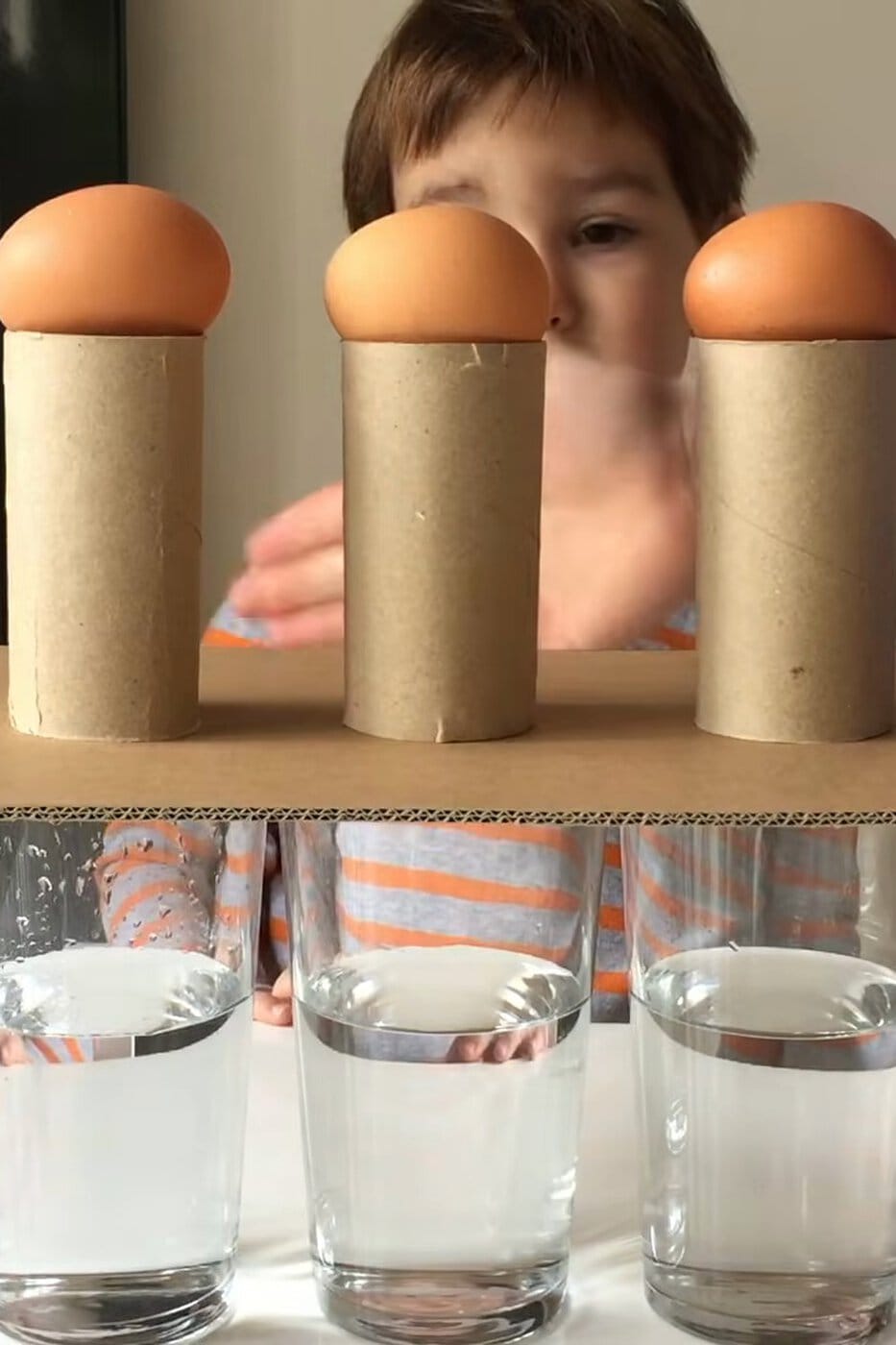
If you are feeling more adventurous why not try lining up three glasses, laying a large flat piece of cardboard across them with a tube and egg above each glass, and see how many eggs you can get to fall simultaneously.

You can try the same trick with a coin: lay a postcard over a glass, put a coin on top and flick the card away sideways. Where does the coin go?
Once you have mastered this trick you can make it even more exciting for your friends by using different coloured water or you can tell them the last time you did this everyone in the audience was covered in egg!
Frequently Asked Questions
What does the egg drop experiment teach?
It shows inertia: a still object stays still unless a force moves it. It also shows gravity pulling the egg down once its support has gone, and how water can slow a falling object gently.
Is this the same as the egg drop challenge?
No. In the egg drop challenge you build a padded container and drop an egg from a height to see if it survives. This version is a quick inertia trick: the egg drops a short way into a glass of water. Both use the same idea at the end, though: slowing the egg down gently stops it cracking.
How do you stop the egg from cracking?
Make sure it lands in water: put the tube right above the mouth of the glass and hit the plate quickly and level, so the egg drops straight down. The water slows it gently. If it still cracks, add a little more water so it has further to slow down.